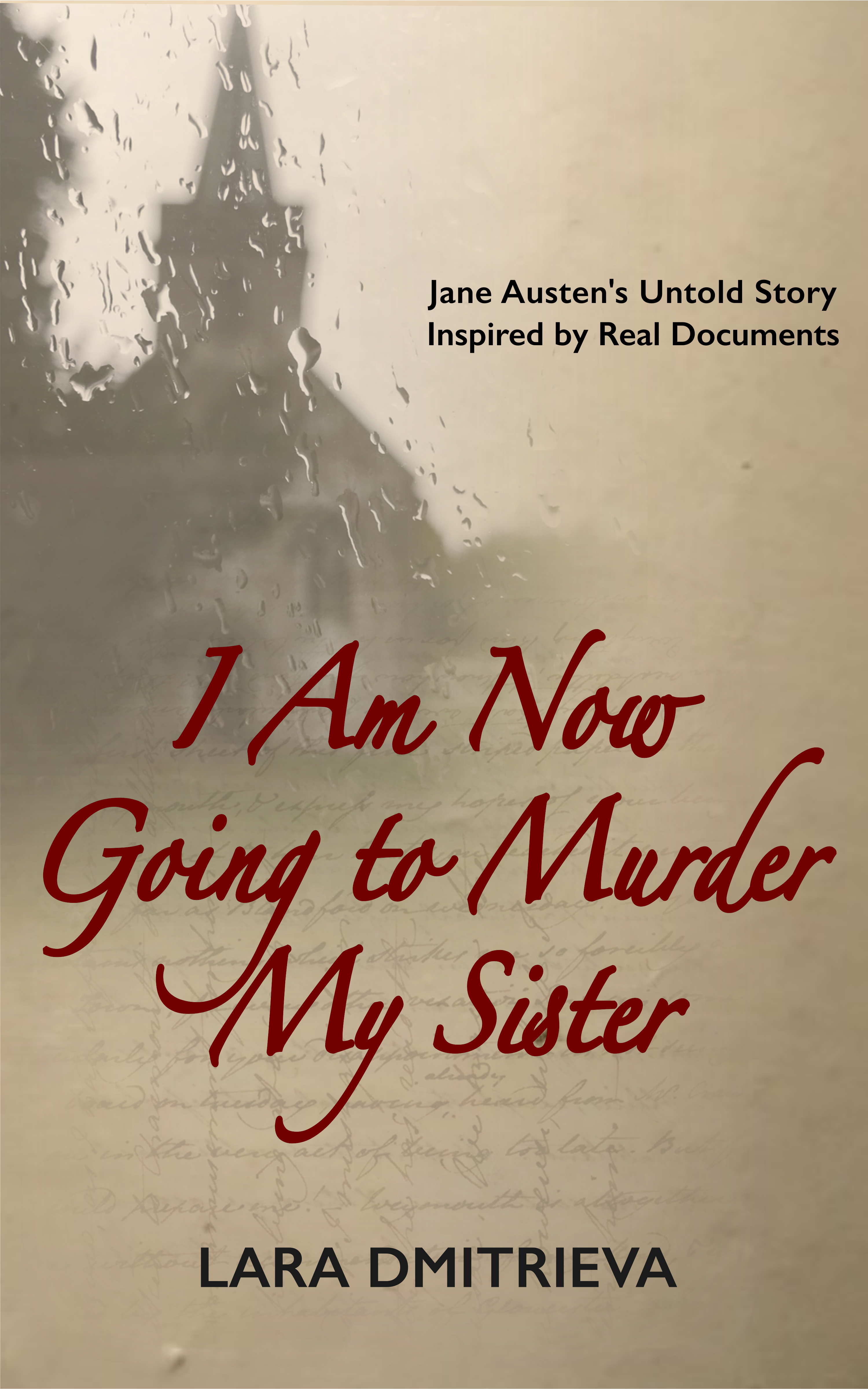
Jane Austen wrote these chilling words over two centuries ago.
History recorded it as a piece of harmless fiction.
But LAPD Detective Ann knows a cover-up when she sees one.
When her sister Samantha ropes her into a seemingly playful Regency book-club investigation, Ann begins dissecting the accepted history like an active crime scene, flipping everything we know about Jane Austen's family upside down. She spots what no literary scholar was trained to look for: motive, means, and opportunity.
Using real historical documents, medical reports, Austen’s writings, along with modern forensic techniques, Ann uncovers a shocking trail of blackmail, forged wills, suppressed manuscripts, and symptoms that point toward arsenic poisoning. Cassandra did not burn Jane’s letters to protect her reputation. She burned them to protect someone else.
But exposing the greatest literary secret in history comes with a price. When Ann gets closer to the truth, she realizes someone in the present day is willing to do whatever it takes to keep it buried.
Goodreads Reviews
Read a Bonus Story from Ann’s Investigation
Clues
Yard sales and antique malls had never been Ann’s cup of tea. Unlike her sister, Samantha, who never missed an opportunity to visit one and always found something to bring home, Ann believed in minimalism, bought only what she could use, and avoided yard sales, flea markets, and antique stores at all costs. If people were selling stuff they no longer needed, she didn’t need it either.
And now, against all her principles, Ann found herself standing among those very unwanted objects. She looked around, trying to figure out how the items were organized so she wouldn’t waste time wandering past the displays. The vases, watches, jewelry, lamps, pictures, figurines, and unidentifiable objects all seemed smashed together with no visible pattern.
“Are you all right there?” A tall, friendly-looking woman with an illegible name badge pinned to her striped T-shirt began her usual customer-service patter. “We’ve got over forty dealers here. Each cabinet is run by a different dealer.”
So, Ann thought, there is a system behind this clutter.
“We have a lovely collection of vintage watches,” the shop assistant continued. She seemed to have decided, somehow, that watches were the reason Ann had come to the antique shop. After judging Ann’s reaction, the shop assistant tried another approach. “Are you looking for anything in particular?”
“Yeah… a clue,” said Ann, scanning the room. “I’m looking for a clue.”
“A clue? Are you on some sort of treasure hunt?”
“Some sort,” Ann replied with a wry smile. “But that’s okay. I think I’ll go.”
“Wait, wait. What should it look like—your clue?” The woman seemed determined not to let her leave without a purchase. “Do you know which dealer we should be checking?”
“Nope. But I’m fine.” Ann resisted the woman’s enthusiasm. “I just made a detour to Salisbury to see the Magna Carta while I’m in the UK.” She smiled. “You know, the rule of law and all that. To see where it started. I deal with the law every day back home.” Ann caught the shop assistant’s suspicious look. “I mean, I’m a detective. Clues, evidence… that kind of thing.” She shrugged. “But all my clues are in Warwickshire and Berkshire. Anyway, thanks for taking the time.” She smiled again and turned toward the door.
“Warwickshire? We’ve got a dealer from Coventry here. Let me show you.” Before Ann could object, the shop assistant guided her to the opposite corner of the room. “We get a lot of tourists like you, and we work with dealers from all over the country. Here it is.”
She pointed to a small, crowded stand. “There are pictures and books. Here, you have watches. All sorts of clues, really. I’ll leave you to it.”
With that, the woman hurried over to prevent another visitor from escaping without a purchase.
Ann stood for a moment, looking at crumpled cardboard boxes piled with old, dust-covered pictures. Since I’m already here, why not try? Coventry is close enough. She began going through them slowly, one by one. Old advertisements, old illustrations, old prints… Once, they had made sense to someone. But she was looking for one that still did.
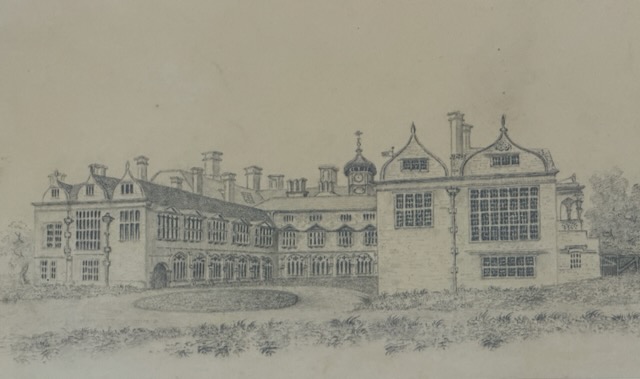
She stopped at a neat pencil drawing of an estate. The windows, the chimneys… No way, she thought. She took the drawing from the box and examined it closely.
The pencil drawing Ann finds among the old pictures. (From the author’s personal collection.)
It was the same estate from the watercolor she had seen at the Coventry museum: Coombe Abbey by Maria Johnson. The same attention to detail and the same compressed perspective along the long facade. It was obviously by the same artist, but this one was not colored. It was a preliminary sketch.
Wow! Ann could not believe her luck. She began examining the other items for sale at the stand with practiced efficiency, slipping into professional mode. It felt like one of her usual suspect searches. She went through the rest of the pictures, then turned to the books.
Nothing so far. Ann sighed. That was okay; the pencil drawing was already a win. She had hoped to find a clue, but instead had found another piece of evidence. Just as she was about to leave, a small plastic bag of postcards caught her eye, bound with an old green rubber band and tucked on the upper shelf behind the family photo albums she had somehow missed.
They didn’t have postcards back in the eighteenth century, but it was worth checking. You check everything during a warrant search, especially the things that looked irrelevant.
Ann pulled out an assortment of yellowish postcards from the early twentieth century, including a couple with Regency Bath views—at least, how people in the 1930s imagined the Regency lifestyle. But among the postcards were a few old yellowed letters. The handwriting was difficult for a modern person to read, but one letter, beautifully written and still legible, caught her attention.
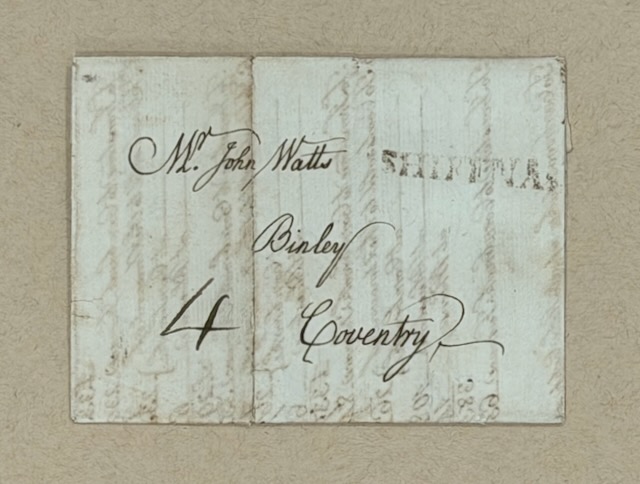
Someone had placed it in a separate plastic bag. No wonder. It belonged in a museum for the handwriting alone, Ann thought. She carefully pulled the yellowed paper from the bag. The red seal… The precise lettering read: Mr. John Watts. Binley. Coventry.
The letter that changes Ann’s investigation. (From the author’s personal collection.)
Ann unfolded the fragile paper and froze.
You’ve got to be kidding. Unbelievable.
Binley… Bingley… Ann whispered both names. Spoken aloud, they were close enough to pass for one another.
Suddenly, the name Caroline Bingley made perfect sense.
Ann tried to make out the rest of the letter.
“How are you getting on here? Any luck with your clue?” The shop assistant was back.
Ann flinched. “More than I hoped,” she said, reaching for her credit card as if the letter might disappear if she didn’t pay fast enough. “I’ll take this letter and this pencil drawing.”
“How lovely! Here’s our business card. You might leave a review online, so people know where to look for clues. Would you like me to wrap these for you?”
“No, thanks. I have a folder.” Ann opened her backpack. “Some clues have been overlooked for two hundred years, even though they’ve been right in front of us all this time.” She put the letter and the drawing in her evidence folder and looked up at the shop assistant. “But not anymore.”
Finished the book? Enter your email
to receive the spoiler-filled discussion guide.
About the Author
Lara Dmitrieva is a data engineer, data analyst, and a member of the Jane Austen Society of North America (JASNA). Her analytical approach led her to investigate why there are gaps in Jane Austen’s surviving letters and in the accepted story of her life. That research became the foundation for her dual-timeline mystery, I Am Now Going to Murder My Sister.
Are you in a Book Club? Lara is available for virtual and in-person Q&As with book clubs reading the novel! Reach out below to schedule a talk.
Join the Team
Join the investigation. Enter your email below to receive news and updates.
Selected Bibliography
Every historical document, medical report, and letter mentioned in this novel is real. Below is a selected list of the historical, literary, and forensic sources used to investigate this 200-year-old cold case.
Austen, Jane. Jane Austen’s Letters. Edited by Deirdre Le Faye. 4th ed. Oxford University Press, 2011.
Austen, Jane. Letters of Jane Austen. Edited by Edward, Lord Brabourne. Richard Bentley & Son, 1884.
Austen, Jane, and Her Family. Charades &c., Written a Hundred Years Ago. Spottiswoode & Co., 1895.
Austen-Leigh, William, and Richard Arthur Austen-Leigh. Jane Austen: Her Life and Letters, A Family Record. Smith, Elder & Co., 1913.
Jane Austen, letter to Cassandra Austen, Steventon, Thursday, January 16, 1796, in The Letters of Jane Austen, selected from the compilation of Edward, Lord Brabourne, by Sarah Chauncey Woolsey. Boston: Little, Brown, and Company, 1908. Project Gutenberg. View source.
Historical and Biographical Sources
Angus, William, engraver. Seats of the Nobility and Gentry in Great Britain and Wales, in a Collection of Select Views. Published by W. Angus, Gwynne’s Buildings, Islington, Feb. 1, 1787.
Baily, J. T. Herbert. Francesco Bartolozzi, R.A.: A Biographical Essay, with a Catalogue of the Principal Prints, and a Six Years’ Record of Auction Prices. London: Otto Limited, 1907.
Bigg-Wither, Rev. Reginald F. Materials for a History of the Wither Family. Warren & Son, 1907.
Craven, Elizabeth. The Beautiful Lady Craven: The Original Memoirs of Elizabeth, Baroness Craven. Edited by A. M. Broadley and Lewis Melville. 2 vols. London: John Lane, The Bodley Head, 1914.
Great Britain. Parliament. House of Lords. Committee for Privileges. The Leigh Peerage. 2nd ed. Vol. 1. London: H. K. Causton, 1832.
Griffin, Charles. “Draft Petition of Charles Griffin to the House of Commons against Lord Leigh.” Crewe MS/3. Trinity College Library, Cambridge, 1849.
Houblon, Lady Alice Archer. The Houblon Family: Its Story and Times. Vol. II. London: Archibald Constable and Company, Ltd., 1907.
Nokes, David. Jane Austen: A Life. London: Fourth Estate, 1997.
Stokes, Penelope. Craven Country: The Story of Hamstead Marshall. P. Stokes, 1996.
Literary and Cultural Context
Edgeworth, Maria. Rosamond: A Sequel to Early Lessons. R. Hunter, 1821.
Fielding, Henry. The History of Tom Jones, a Foundling. A. Millar, 1749.
Gregory, Dr. John. A Father’s Legacy to His Daughters. W. Strahan and T. Cadell, 1774.
Griffith, Elizabeth. The History of Lady Barton. T. Davies, 1771.
Halifax, George Savile, Marquess of. The Lady’s New-year’s-gift: or, Advice to a Daughter. Matt. Gillyflower, 1688.
Radcliffe, Ann. The Mysteries of Udolpho. G. G. and J. Robinson, 1794.
Medical, Poisoning, and Forensic Sources
Watson, Katherine D. “Medical and Chemical Expertise in English Trials for Criminal Poisoning, 1750–1914.” Medical History 50, no. 3 (2006): 373–390.
Watson, Katherine D. “Poisoning Crimes and Forensic Toxicology since the 18th Century.” Academic Forensic Pathology 10, no. 2 (2020): 84–95. PubMed Central. View source.
Holmes, M., & van Heerden, I. (2019, February 1). Britain’s long relationship with agricultural chemicals since the mid-eighteenth century. Centre for Research in the Arts, Social Sciences and Humanities, University of Cambridge. View source.
Isaac, Susan. “Arsenic: A Domestic Poison.” Royal College of Surgeons of England, 12 Oct. 2018. View source.
Jabr, Ferris. “Was Jane Austen Poisoned by Arsenic? Science May Soon Find Out.” Scientific American, 5 Dec. 2011. View source.
“Jane Austen’s poor sight ‘caused by arsenic’.” BBC News, 9 March 2017. View source.
Sanders, Michael D., and Elizabeth M. Graham. “‘Black and White and Every Wrong Colour’: The Medical History of Jane Austen and the Possibility of Systemic Lupus Erythematosus.” Lupus 30, no. 4 (2021): 549–553. View source.
Hogg, Jabez. Arsenic and Arsenical Domestic Poisoning. London: McGowan’s Steam Print. Co., 1879. Internet Archive. View source.
Mohamed AS, Elhafez AEA, Ahmad MMN. Mitigating the harmful consequences of arsenic on celosia plants via the use of GABA. BMC Plant Biol. 2026 Mar 13;26(1):637. doi: 10.1186/s12870-026-08384-2. PMID: 41820824; PMCID: PMC13064408. View source.
Articles, Archives, Exhibitions, and Online Resources
Barchas, Janine. “More about Cassandra and the Art of Copying.” Persuasions On-Line 45, no. 1 (Winter 2024). Jane Austen Society of North America. View source.
“Jane Austen, the Cravens and the Leigh Family.” Elizabeth Craven and Her World, 21 Nov. 2021. View source.
“Jane Austen’s Letters.” The Morgan Library & Museum, 2025. View source.
LACMA. Woman’s Dress (Round Gown), England, circa 1795. Cotton plain weave with metallic embroidery. Accession no. M.57.24.12. View source.
Le Faye, Deirdre. “Anna Lefroy and Her Austen Family Letters.” The Princeton University Library Chronicle 62, no. 3 (Spring 2001): 519–562. View source.
Lock, Theresa A. “The Man Who Remembered Jane Austen: Kintbury’s Rev Fulwar Craven Fowle.” Kintbury and Beyond, 16 Dec. 2025. View source.
Beaumont, D. “‘I, Me, Myself’: Selfhood and Melancholy in the Journals of Gertrude Savile (1697–1758).” Journal for Eighteenth-Century Studies, 5 Feb. 2026. View source.
Lundy, Darryl. The Peerage: A Genealogical Survey of the Peerage of Britain as Well as the Royal Families of Europe. View source.